Why I built RV Travel Scout
Human Touch
Let’s say you’re towing your RV through Colorado. You’re heading north on CO-69 and have a decision to make. Stay on 69 until you hit US-50, then head east toward your final destination? Or take Colorado Road 1A, which appears to be the perfect scenic shortcut and would cut the distance to Cotopaxi by half?
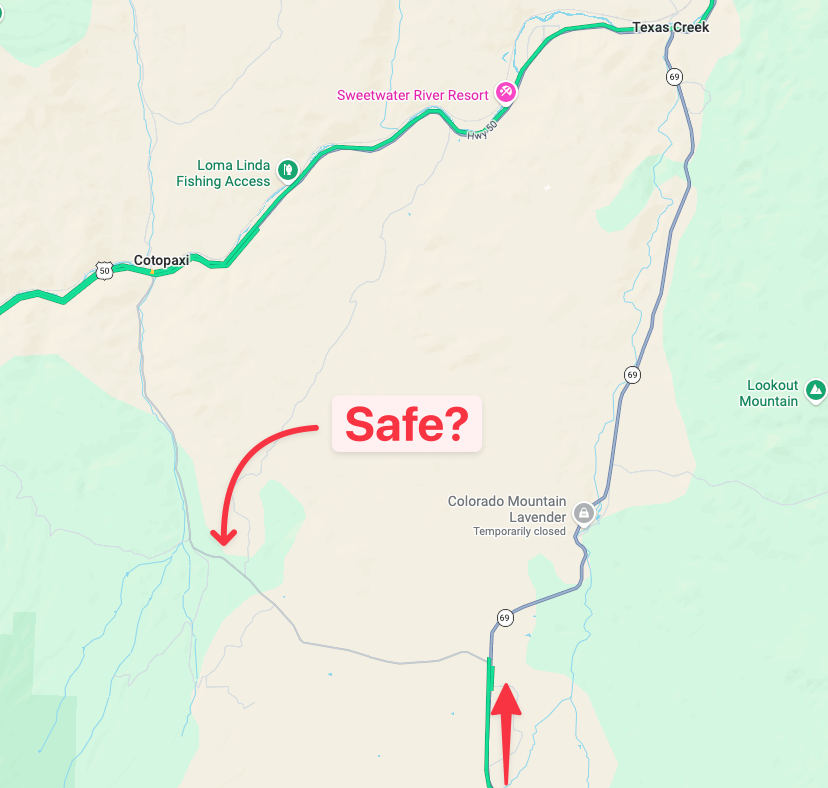
Road 1A might be suitable for your rig. Then again, it might not be. So what do you do? How do you decide which path to take?
When my wife and I encounter these sorts of navigational conundrums, we probably do the same things you do: examine satellite imagery on Google Maps, and if Street View happens to be available, “walk” the road, looking for indications of safety or peril. I’ll even toss something like “Colorado Road 1A RV towing” into a Google search to see what comes up. If I’m lucky, I’ll unearth a forum thread where multiple people relayed their experiences towing on the exact section of road I’m concerned about. If I’m really lucky, the thread will be less than a decade old. These days you could probably also ask ChatGPT or Gemini for advice, although I wouldn’t recommend it given AI’s propensity for false inferences. Over the past four years and 35,000 miles of towing, this combination of Google Maps, satellite imagery, Street View, and forum searches has worked out reasonably well for us. However, I’d primarily characterize these as planning tools. Once your wheels are in motion and decisions become time-sensitive and impromptu, they’re far less helpful—especially if your internet connection is spotty and your only device is a phone. In our experience, this is when unfortunate road selections are most likely to happen.
Regardless of whether you’re planning ahead or navigating on the fly, there’s really no substitute for human observation, commentary, and feedback. Digital maps, satellite imagery, and Street View are all indispensable technologies. Honestly, I don’t know how people ever traveled long distances by road without them. But I still give more weight to the advice provided by fellow RV travelers who have direct experience traversing the roads I’m eyeing for my own journey. Just last summer we abandoned our plans to take a certain Colorado road because I found a thread where multiple RVers claimed it was a bumpy, potholed mess. (Which road, you ask? Sadly, we can’t recall.) That morning we had discovered an abnormal bulge in one of our tires, so we opted for a safer, smoother route to a wonderful Discount Tire in Grand Junction. Now of course, one person’s scenic paradise can be another’s white-knuckled nightmare (looking at you, Million Dollar Highway), so getting multiple perspectives is critically important too. Yet somehow, as far as I’m aware, nothing on the internet exists that facilitates the collection and aggregation of this type of information—from RVers and for RVers—into a single, searchable database.
That’s why RV Travel Scout Roads was built: To give RV travelers a dedicated place to collectively document the roads we’ve conquered, avoided, regretted, and recommended to one another for years. Instead of digging through scattered forum threads and hoping someone recently asked about the same route, travelers can now browse dedicated road listings filled with firsthand experiences, drivability feedback, hazards, warnings, and recommendations from fellow RVers.
While the lack of an RV-centric road repository might be the most glaring void, it is by no means the only one. Say you want to find a list of reputable service centers with deep knowledge of your brand of RV. I know there’s no such thing for Airstreams, and I’d bet there isn’t anything for your brand either. What’s your technique for locating gas stations with ample space for maneuvering your rig around the fueling bays? If you drive a diesel, you can use the same wide-open lanes as commercial trucks, but those aren’t always available when you need one. What about those of you with gassers? In certain areas of the country, finding a sufficiently spacious station can be a crapshoot even with GasBuddy and Street View at your disposal. (Assuming you have an internet connection.) Now imagine you’re looking for a rest stop. How do you find one? Google Maps, right? Yeah, us too. But Google Maps doesn’t make it easy to zero in on one with a dump station. Or indicate whether the parking lot is huge or tiny, potholed or smooth. And it certainly wouldn’t include spots that, strictly speaking, aren’t even “rest stops,” like this hidden gem.
RV Travel Scout will serve as a grand unifier, consolidating allllll the information that is currently scattered across decades of websites, forums, and Facebook groups into a single, harmonious internet paradise.
Everywhere you go with your RV, reviewed.
The internet is absolutely brimming with places for reading and writing reviews of RV parks and campgrounds. Most of them focus on only one part of the journey. Generic platforms like Google Maps, Yelp, and TripAdvisor rarely capture the details RV travelers actually care about, while RV-focused platforms tend to concentrate primarily on campgrounds and campsites. But RV travel is about far more than where you sleep for the night. It involves navigating unfamiliar roads, finding RV-friendly fuel stops, locating dump stations and rest areas, and discovering trustworthy service centers when things go wrong.
RV Travel Scout brings all of these experiences into a single platform. In addition to RV parks and campgrounds, Travel Scout includes reviews and information for rest stops, fuel stations, dump stations, roads, and service centers, helping RV travelers make more informed decisions everywhere the road takes them. Our reviews are deliberately comprehensive. Instead of reducing an experience to a single star rating, Travel Scout captures detailed feedback across specific factors RV travelers actually care about, from road drivability and fuel station accessibility to RV site spacing, cleanliness, and service quality. Have you ever stayed at an otherwise fantastic RV park, but felt compelled to lower your overall rating because their laundry machine ruined your favorite pair of pants? With Travel Scout, you’ll never have to play that game again. Here you can bestow 5 stars on the park itself while scorning the laundering facilities with the pathetic 1-star rating it deserves.
Find what you’re looking for
When I’m researching places to go with my RV, one of the best ways to hone in on suitable options is to quickly eliminate results that don’t meet my needs. That’s why I made searching and filtering first-order considerations on RV Travel Scout. Every bit of metadata collected for our listings can be used to focus your searches. We aim to capture the details that matter most to RV travelers, while consciously avoiding the fluff no one cares about.
That means you can search for the things that actually influence your travel decisions: whether an RV park will accept the package you ordered from Amazon, whether a rest stop has a dump station, whether a fuel station is easy to maneuver, whether a service center is experienced with your brand of RV, or whether a road has steep grades, tight turns, low clearances, or other hazards worth knowing about before you commit. The goal isn’t to bury travelers under more data. It’s to help them cut through the noise faster, rule out bad fits sooner, and spend more time evaluating the options that might actually work.
Find RV travelers just like you
On more than a few occasions, I’ve spotted RVers on other review platforms who seemed just like us. Similar tastes, similar rigs, similar habits. They seemed to value the same things we do: beautiful scenery, quiet atmosphere, and enough space so the neighbor’s stinky slinky isn’t routed underneath our picnic table. Every time I’ve encountered someone like that, I’ve wished I could follow them and get proactive notifications whenever they publish new reviews.
That is one of the features of RV Travel Scout I’m most excited about. When you follow travelers whose judgment you trust, their experiences become part of your own planning radar. If they find a hidden-gem campground, you hear about it. If they regret staying somewhere, you hear about that too. If they discover a service center worth driving out of your way for, or one you should avoid at all costs, now you have the same intel. The power of RV Travel Scout isn’t just that it stores reviews. It’s that it can help the right reviews find the right people.
Need a Scout to Follow?
I’ve reviewed dozens of RV destinations, roads, rest areas, fuel stations, and service centers. Click here to see what I discover next.
This is just the beginning
My background is in software development. (To the shock of no one, I assume.) In that world, “MVP” is a ubiquitous acronym. It stands for Minimum Viable Product. In the context of creating a new software application, it refers to the notion that you should initially build the smallest functional version of your product possible in order to get it into the hands of your target audience earlier rather than later. This can be a bit counterintuitive because it almost sounds like you’d be releasing a product that isn’t done yet. But that’s not quite right. The true objective is to avoid building something in a vacuum for years, only to release something no one likes.
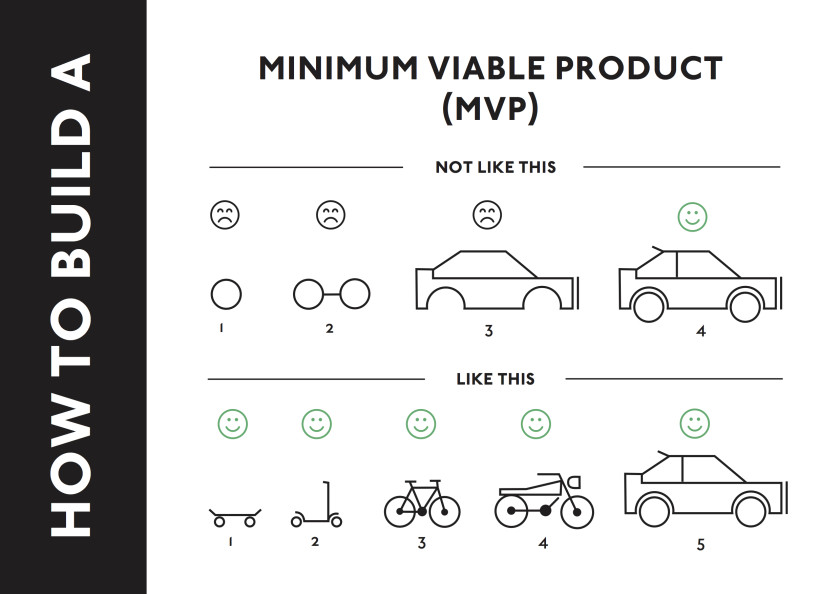
RV Travel Scout is very much an MVP. I have a long and growing list of features and improvements I want to add over the coming months, and I’m super excited for the future of the platform. But right now I’m even more excited that I can say RV Travel Scout is officially open to RV travelers everywhere and ready to be put to work.
Sign up today. It’s free!
RV Travel Scout is live, free to join, and ready for your contributions! Create an account today to start exploring listings, following fellow RV travelers, saving useful places, and contributing your own hard-earned knowledge to the community. The more of us who share what we’ve learned—from great campgrounds and easy fuel stops to rough roads and service centers worth trusting—the more useful RV Travel Scout becomes for everyone who travels by RV.